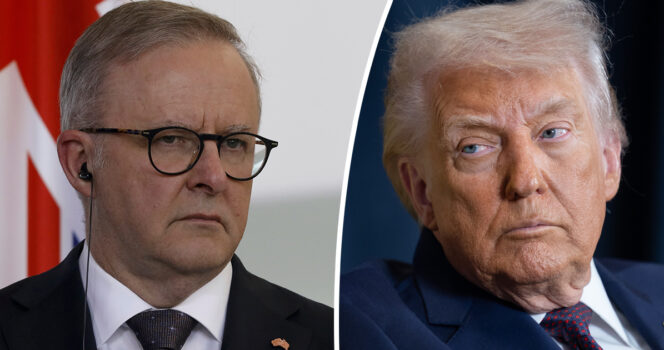
The U.S. war in Iran has been ongoing for months. Several countries have refused to help the Trump administration in the Middle East, and now one prime minister has spoken out. On Monday, Australian Prime Minister Anthony Albanese issued a blunt warning to Trump—urging him to be more precise about the U.S. objective in Iran.
The U.S., alongside Israel, began its military operation in Iran. While President Donald Trump has claimed the war has been “won,” recent reports that the Pentagon is planning to deploy troops to Iran suggest otherwise.
According to U.S. officials quoted by The Washington Post, the Pentagon is preparing for a ground operation in Iran. However, it would be limited to raids by special operations forces and infantry troops, not a full invasion.
Troops could be involved in potential coastal sites near the Strait of Hormuz, according to officials cited by the Post, as well as in raids on the strategically important Kharg Island in the Persian Gulf. Its port handles up to 90 percent of Iran’s crude oil exports.
As of today, it remains unclear whether Donald Trump will approve the Pentagon’s plans. In a statement responding to questions about the Washington Post report, White House press secretary Karoline Leavitt said, “It’s the job of the Pentagon to make preparations to give the Commander in Chief maximum optionality.” She added that this does not mean the president has made a decision.
Australia issues scathing warning to Trump over Iran war Donald Trump has asked allies for help reopening the Strait of Hormuz. However, European countries, as well as Australia and Japan, have ruled out sending warships to the region.
Trump has previously criticized Australia for failing to do more to help the United States secure the Strait of Hormuz.
“[UK Prime Minister Keir Starmer] didn’t want to help us,” Trump previously said. “‘Australia, too. Australia was not great. I was a little surprised by Australia.’”
Now, Australian Prime Minister Anthony Albanese is pushing back at Donald Trump. During a speech in Canberra on Monday, he called out the U.S. presidency for lacking a clear plan and said the rest of the world has not been given a clear understanding of America’s real objectives in the Iran war.
He sent a blunt warning to Trump, saying it will be difficult to successfully carry out a regime change in Iran.
“I want to see more certainty in what the objectives of the war are, and I want to see a de-escalation,” Albanese said, per the Daily Mail, stressing that reducing tensions should be a regional priority.
“At the beginning of the conflict, the objectives were outlined as one: stopping Iran from getting a nuclear weapon, and I agree that has clearly been achieved.”
“Very difficult” He further stated that a second goal—to curb Iran’s capacity to project military power both internally and through its regional proxies—had also been accomplished.
“The second objective was degrading the opportunity that Iran has for engaging in military action, either overtly or through its proxies in Hezbollah, Hamas, and the Houthis, and clearly there has been substantial degrading of Iran’s position,” the Australian Prime Minister explained, adding that he has serious concerns about the U.S. being unable to carry out a regime change.
He warned Trump that history shows outside attempts to impose regime change rarely succeed and often lead to further instability.
“The third objective was regime change, and I think history tells us very clearly that regime change imposed from outside is very difficult and tends to happen from the bottom up within a country, rather than being imposed from outside,” Albanese continued.
“I would like to see the Iranian regime, which I regard as abhorrent and reprehensible, replaced. I certainly stand with the Iranian people who have been subjected to abuse, human rights atrocities, and oppression for a long period of time, particularly women and minority groups who have been persecuted by this abhorrent regime,” the PM concluded.
What do you think about this? Please share your thoughts in the comment section.