Cosmetic procedures like lip, nose, cheek, or forehead enhancements have become increasingly common. With so many providers offering services, it’s crucial to choose a qualified medical professional — something Gina Anderson from Oregon learned far too late.
Anderson, a neurologist, wanted to “look better” when she turned 40 and decided to try cosmetic fillers. A colleague offered to help, but years later, the decision led to devastating consequences.
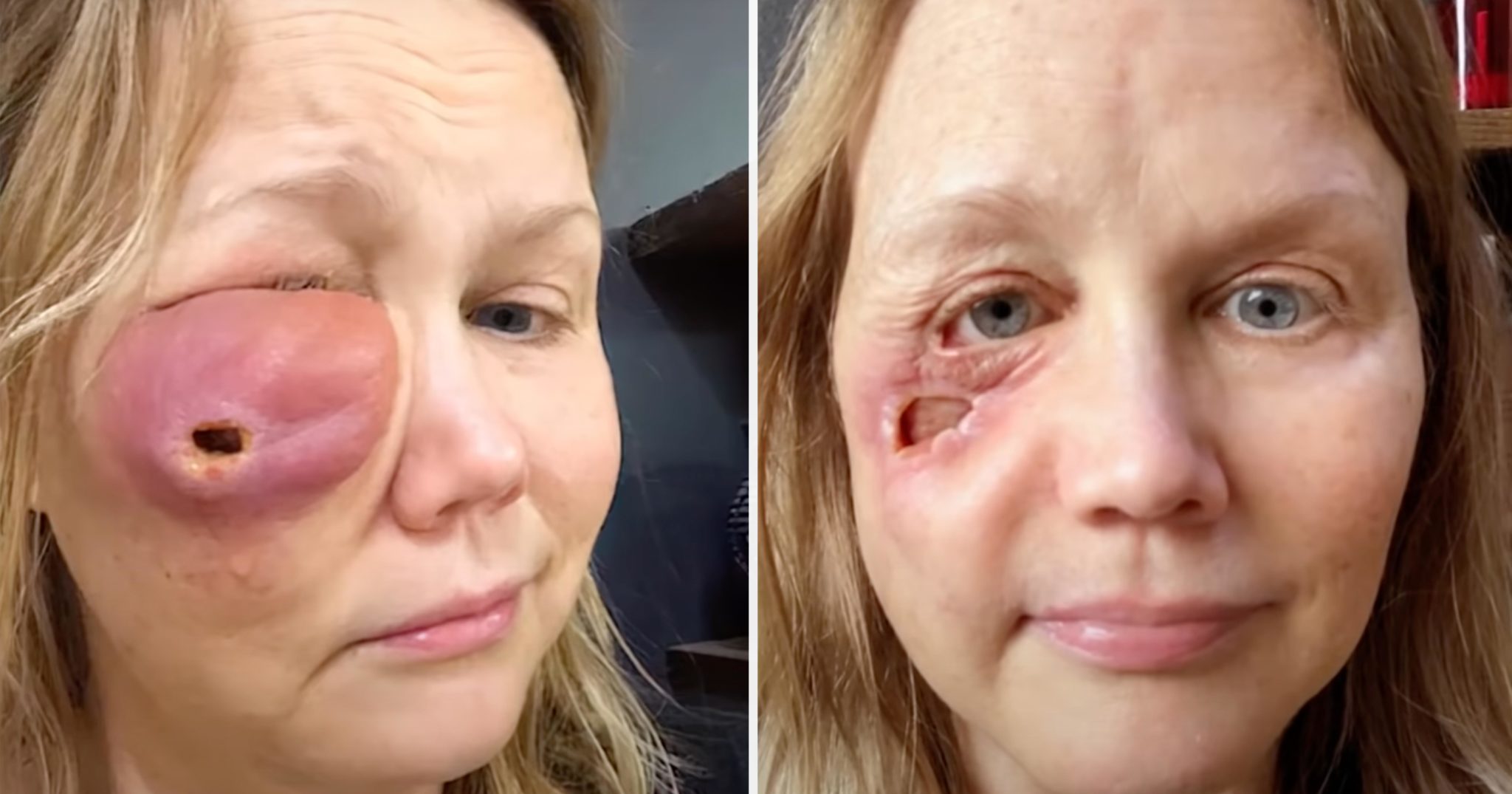
Gina developed severe inflammation under her right eye, and doctors eventually discovered she had been injected with silicone. The problem worsened over time, eventually leaving her with a large wound on her cheek.
Desperate for help, Gina turned to the doctors on the television series Botched. This is what happened — and what she looks like today.
Why Gina sought fillers
Feeling comfortable in your own skin is important, whether you’re tall or short, thin or curvy, bald or hairy. Many people make small changes — new hairstyles, gym routines, or even cosmetic procedures — to feel more confident. But any medical procedure should always be done by a licensed specialist.

Gina, unfortunately, trusted the wrong person. When she turned 40, she wanted a small refresh.
“A colleague offered to do fillers for me, and it was like, ‘Well, I’m in my 40s, I’m going to look a little bit better,’” she said on Botched.
She believed she was receiving Restylane or Juvederm. Instead, she was injected with silicone — something she never consented to.
The complications began
The silicone caused significant inflammation and distortion around her right eye and cheek. Although she had injections on both sides of her face, only one side contained silicone. Gina and her husband later concluded that two different products must have been used.

Four years later, the effects became severe. The inflammation formed a granuloma — a cluster of immune cells reacting to a foreign substance. While granulomas are meant to protect the body, Gina’s caused swelling that grew rapidly.
Then, suddenly, the inflamed area opened.
Multiple failed surgeries
Gina sought help and underwent five corrective surgeries to remove the silicone, but the granulomas kept returning. Eventually, she was left with a large wound on her cheek.
“I had to close my practice,” she said. “You can’t sleep, and you’re in constant pain. I was exhausted, weak, and my hair started thinning. It’s been a nightmare.”
With nowhere else to turn, she contacted Dr. Terry Dubrow and Dr. Paul Nassif from Botched.

Dr. Dubrow explained that granulomas typically appear within a year of injection. Gina’s delayed reaction suggested a slow, chronic inflammatory response that could be extremely difficult to treat.
Treatment on Botched
Although Gina’s previous surgeries had closed the wound, she still needed two more procedures at the Botched clinic. Doctors transferred fat from her abdomen to restore volume in her cheek.
During surgery, Dr. Nassif found unexpected material — something resembling a piece of gauze — embedded in her face.

After the procedure, Gina finally felt relief. Her pain decreased, she could sleep again, and she felt hopeful.
But complications returned. Swelling reappeared due to recurrent seromas — pockets of fluid that kept forming in her cheek. She needed yet another surgery.
“My only option is to open her up again, remove the capsule causing the fluid buildup, and hope this resolves it,” Dr. Nassif said.
Gina’s recovery today
The second surgery finally worked. Gina was thrilled with the results, and her face returned to a natural appearance.

“My energy is increasing, my mood is better, and my hair is growing back,” she said. “It’s a miracle. It’s life‑changing.”
Gina looks wonderful now — confident, healthy, and relieved to have her life back.
A reminder about cosmetic procedures
Plastic surgery and cosmetic treatments should always be performed by licensed, experienced professionals. If you’re considering any procedure, research thoroughly and choose a qualified expert.
And while some people choose to change aspects of their appearance, it’s equally important to embrace who we are. Confidence, self‑acceptance, and self‑care matter just as much as any physical change.
Please share this story with friends and family on Facebook.