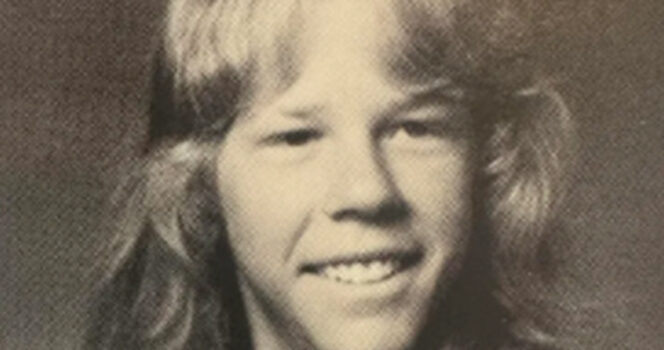
For one rock legend, pain didn’t just shape his story — it became the core of his sound.
Long before sold‑out stadiums and worldwide fame, this kid was carrying unimaginable loss. He lost both of his parents at a young age, leaving emotional scars that never fully faded.
Born on August 3, 1963, he was the son of a light‑opera singer and a truck driver. He grew up in a blended family with two older half‑brothers and a younger sister.
But his childhood was anything but typical. His parents were devoted Christian Scientists, a faith that rejected modern medical care.
“It was very alienating for me as a child, being raised in this religion and how I couldn’t attend certain health classes at school. They’d get their health books out and I wasn’t supposed to learn about the body because ‘this is just a shell for your soul’ and all of this,” the star once shared.

At just 13, while he was away at church camp, his father abruptly left the family without even leaving a note. His mother told the children he was simply on a business trip.
After his parents divorced in 1976, the singer threw himself into music and football. But even then, he felt pressure to fit in — when his coach told him to cut his hair, it became another moment where he felt torn between expectations and staying true to himself.
“It felt lonely,” he told The New Yorker. “I didn’t get it. I thought something was wrong with me.”
Not long after the divorce, tragedy struck again.
His mother became seriously ill with cancer but refused treatment because of her beliefs. He had to watch her condition deteriorate, unable to do anything.
“We watched her wither to nothing,” the singer remembered.
The experience left a permanent mark.
After his mother’s death, he went to live with his older half‑brother David.
With no real outlet for his grief, he turned to the one thing that made sense — music.
He moved in with his half‑brother in La Brea and poured himself into playing, joining bands with names like Obsessions, Syrinx, Phantom Lord, and Leather Charm.
A really, really shy kid “I couldn’t write a lyric to save my life,” the frontman later admitted — and early song titles like “Hades Ladies” and “Handsome Ransom” made that obvious. Still, he wasn’t content just playing covers. He wanted something more.
“I wanted it to be freedom from school, from work, from the typical music that we were hearing,” he told NPR. “It was a way to get away from my screwed‑up family.”
Instead of words, he leaned on guitar riffs. Instead of silence, he made noise — loud, fast, and unapologetic.
That raw mix of grief, anger, and confusion would eventually shape a sound that changed music forever.
“Music was the voice I didn’t have. I was pretty much afraid of everything… afraid of the world, afraid of speaking. [I was a] really, really shy kid. Music was a way to speak,” he explained.
Before long, everything clicked. In the early 1980s, he connected with Danish drummer Lars Ulrich through a local newspaper ad — a meeting that changed both of their lives.
Together, they set out to build something different. Something heavier. Something real.
That partnership became the foundation of Metallica — a band that would redefine heavy metal with razor‑sharp riffs and deeply personal, emotionally charged songwriting.
Albums like Ride the Lightning, Master of Puppets, and …And Justice for All didn’t just earn critical acclaim — they sparked a movement. Then came 1991’s The Black Album, launching them into global superstardom with hits like “Enter Sandman” and “Nothing Else Matters.”
But behind the success was another story.
Fame brought pressure. Years of nonstop touring, unresolved trauma, and the weight of success began to take their toll. His struggles with addiction and anger became impossible to ignore.
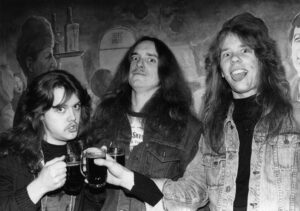
In 2001, everything came to a breaking point. He entered rehab — a moment that changed not only his life, but the band’s future.
“Recovery is the most difficult and challenging thing I’ve ever attempted (along with parenting),” he wrote. “[It’s] also the most grounding and gratifying gift I’ve ever received (along with parenting).”
The aftermath was captured in the brutally honest documentary Some Kind of Monster, where fans saw a rarely shown side of rock stardom: vulnerability, conflict, and the long road to healing.
Still performing Instead of hiding from his struggles, he confronted them — earning respect not just as a musician, but as someone willing to grow.
“My music and lyrics have always been a therapy for me,” he once said. “Without this God‑given gift, I don’t know where I’d be.”
More than 40 years into his career, he’s still standing. Still performing. Still evolving.
His journey isn’t just about music — it’s about resilience. About turning pain into purpose. About refusing to let the past dictate the future.
And that’s what makes his story so powerful.
Because the man behind it all — James Hetfield — didn’t just help define a genre. He showed millions that even the darkest chapters can lead to something extraordinary.
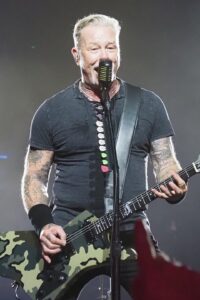
James Hetfield’s story is undeniably powerful — but it also raises a bigger question.
Did his pain shape the artist he became, or is that something we tell ourselves when greatness comes from struggle?
There’s no doubt his experiences gave his music a raw, emotional edge — but was it worth the cost?