There are Hollywood stars, and then there are immortal legends — names that dominate theaters, magazines, and screens worldwide, and will continue to do so.
But long before the fame, the lights, and the red carpets, this boy was simply a kid trying to survive in a turbulent household.
His father was a bully and a coward — the kind of person who would start kicking when something went wrong.
A childhood shadowed by fear He has earned more than $13.3 billion at the global box office, securing his place among the highest‑grossing actors of all time. And those numbers become even more astonishing when you consider how far he came from his difficult childhood.
This star grew up with learning challenges, constant moves, and a father he described as a violent, destabilizing force — a “merchant of chaos.”
“He was a bully and a coward… He was the kind of person where, if something goes wrong, they kick you,” he said in a 2006 interview.
“He would lull you in, make you feel safe and then, bang! For me, it was like, ‘There’s something wrong with this guy. Don’t trust him. Be careful around him.’”
During his childhood, the future film icon attended fifteen schools in fourteen years.
Trust was risky, and safety was rare. He was small for his age, and bullying at school — combined with the pressure of always being the “new kid” — made every day a struggle.
“So many times the big bully comes up, pushes me,” he recalled. “Your heart’s pounding, you sweat, and you feel like you’re going to vomit. I’m not the biggest guy, I never liked hitting someone, but I knew if I didn’t hit that guy hard, he’d pick on me all year.”
“It was just brutal” All the moving left him withdrawn and somewhat isolated. He couldn’t express his feelings and never felt like he fit in anywhere.
“If someone was new or different, it was just brutal,” he told the Los Angeles Times in 1990.
Being diagnosed with dyslexia at seven only made things harder. Reading and memorizing — skills that would later define his career — were constant challenges, fueling frustration and anxiety throughout his childhood.
“I would go blank, feel anxious, nervous, bored, frustrated, dumb. I would get angry. My legs would actually hurt when I was studying. My head ached,” he said of his early school years.
Started working at 8 Many people don’t know that he spent part of his childhood in Canada after his father accepted a position as a defense consultant with the Canadian Armed Forces.
The family settled in Beacon Hill, Ottawa, in late 1971, where he began fourth grade at Robert Hopkins Public School. There, under teacher George Steinburg, he discovered drama.
Along with six classmates, he improvised a play set to music called IT for the Carleton Elementary drama festival — an ensemble performance praised by organizer Val Wright as “excellent… a classic ensemble piece.”
By sixth grade, life changed again. His mother left his father, taking him and his sisters back to the United States.
With the family struggling, he began working as a child — mowing lawns, cleaning yards, doing whatever he could to help.
“I used to cut grass and had all kinds of odd jobs to give money to my family, but also to save money so I could go to the movies,” he told People in 2018.
“You didn’t have YouTube, and we didn’t have film school. That was my film school.”
For a time, he pursued a Catholic scholarship at St. Francis Seminary in Cincinnati, hoping to join the Franciscan order.
“More than anything, it had to do with the fact that our family didn’t have enough money to feed me,” he once said.
But the path didn’t last — he left after a year, either because his family moved or, according to a classmate, because he was caught with liquor.
Rising from struggle to superstardom At 18, he moved to New York to pursue acting, and within a year, his talent was undeniable. After working as a busboy, he moved to Los Angeles to pursue television roles.
He signed with CAA and soon transitioned to film, making his debut with a small role in the 1981 movie Endless Love. His first real break came later that year with a supporting role in Taps. Originally cast as an extra, his part was expanded after he impressed director Harold Becker.
Two years later, he skyrocketed to fame with Risky Business (1983), a breakout role that set the tone for a career that would reshape modern Hollywood.
In the 1990s, he was named Sexiest Man Alive, and his success has only grown since. Today, he is one of the world’s highest‑paid actors, with three Golden Globes and four Academy Award nominations.
$600 million in the bank But even with $600 million to his name, his father’s shadow lingered. When his father became terminally ill, their reunion came with strict boundaries and emotional distance.
“[He] would only meet me on the basis that I didn’t ask him anything about the past,” he said.
“When I saw him in pain, I thought, ‘Wow, what a lonely life.’ It was sad.”
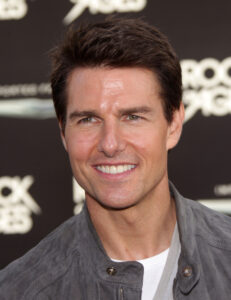
Despite a childhood marked by abuse, anxiety, and constant upheaval, this actor transformed his early hardships into discipline, drive, and the determination that made him one of the most enduring movie stars in history.