It’s chilling to look at photos of innocent children… and then realize some of them grew up to become mass murderers.
We’re wired to see kids as pure, sweet, and untouchable. That’s why seeing a smiling baby who later committed unimaginable crimes hits so hard.
And the seemingly sweet, innocent child we’re about to introduce would one day become one of the most terrifying killers in American history.
On a warm day in May 1960, a baby boy was born in Milwaukee, Wisconsin. His parents — a 23‑year‑old chemistry student and a 24‑year‑old teletype machine instructor — welcomed their first child with hope and dreams for his future. In his earliest years, he was reportedly lively and cheerful, full of energy and promise. But something shifted.
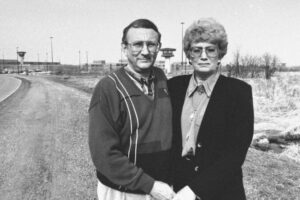
Shortly before his fourth birthday, he underwent double hernia surgery, and his family noticed an immediate change. The once‑bubbly child grew quiet, withdrawn, and increasingly uneasy.
Resentment toward his baby brother By the time he started school at six, the boy was already struggling with feelings of abandonment and had begun to resent his baby brother. Teachers described him as timid and reserved, sensing a child who felt neglected as his father’s studies kept him away and his mother battled depression and hypochondria.
The household was tense. His parents argued constantly, and his mother attempted suicide at least once, demanding constant attention and spending much of her time bedridden. The boy later admitted he never felt his family was stable, never sure if his home would stay intact.
Still, the thin, blonde‑haired boy did have a few friends growing up.
“He was a fun kid to be around as a child,” said Ted Lee, who lived in the same neighborhood. But as he got older, a dark fascination began to surface. Some believe it started when he was four and watched his father dig up animal bones beneath their house.
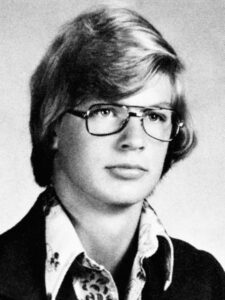
The sound of the bones sparked a strange thrill, and he became obsessed with what he called his “fiddlesticks.” He explored further, searching for bones and even dissecting live animals to study their skeletons.
When the family moved to Bath Township, Ohio, his interest deepened. He began collecting large insects and small animal skeletons in a hut near their wooded property, some preserved in jars of formaldehyde.
His father, assuming it was scientific curiosity, taught him how to clean and preserve bones — skills the boy eagerly embraced.
Escalating obsession The obsession soon escalated. He started gathering roadkill, dissecting animals, and burying them near his hut. Sometimes, he placed skulls on makeshift crosses.
By 14, he had begun drinking heavily, hiding liquor in his jacket and calling it “my medicine.” His parents’ marriage collapsed in a bitter divorce. By the time he graduated in May 1978, his mother had moved out with his younger brother, leaving the 18‑year‑old alone in the family home.
By age 15, he had decapitated a dog, nailed its body to a tree, and impaled its skull on a stick. In high school, he became known for strange pranks — bleating and faking seizures to get attention.
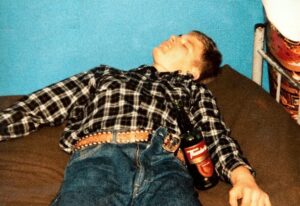
He also mimicked the slurred speech and awkward movements of a man with cerebral palsy who, he claimed, his mother once hired as an interior decorator. Some saw it as cruelty, but others — especially his teenage peers who ignored the tastelessness — found him genuinely funny. Their laughter fueled him. He’d stumble past open classroom doors during lessons, peer through windows from outside, or make strange bleating noises just out of the teacher’s earshot.
“He would bleat like a sheep,” recalled former friend and classmate John Backderf.
“Sometimes he did it loud. He knew it cracked us up.”
First victim But beneath the jokes, darker compulsions were forming.
Just three weeks after graduation, on June 18, 1978, the young man picked up a hitchhiker — and committed his first murder.
Over the next 13 years, he killed 16 more young men, dismembering some and, in horrifying cases, consuming parts of their bodies. Most victims were first drugged with sedatives and then strangled.
His crimes included necrophilia, cannibalism, and attempts to create compliant “zombies” by drilling into victims’ skulls and injecting acid into their brains.
Caught in 1991 He was finally caught on July 22, 1991, when one intended victim escaped and led police to his apartment. Inside, authorities found photographs of dismembered bodies, severed heads in the refrigerator, and a horrifying collection of human remains.
The boy who once played innocently with “fiddlesticks” had become Jeffrey Lionel Dahmer — the Milwaukee Cannibal — one of America’s most infamous serial killers, later chronicled in Netflix’s Monster. Dahmer met his own violent end on November 28, 1994, when he was beaten to death by a fellow inmate at age 34.
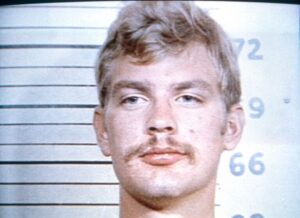
The inmate who killed him, Christopher Scarver, claimed God told him to do it.
When news of Dahmer’s death broke, his mother, Joyce, lashed out at the media, saying, “Now is everybody happy? Now that he’s bludgeoned to death, is that good enough for everyone?”
Reactions from victims’ families were mixed. Some felt relief, while others said the news only deepened their pain. Catherine Lacy, mother of victim Oliver Lacy, said, “The hurt is worse now, because he’s not suffering like we are.”
The district attorney who prosecuted Dahmer urged the public not to glorify Scarver, reminding everyone that Dahmer’s killing was still an act of murder.